Top 5 Astronomy Stories 2025
2025 included a lot of milestones, like the 40,000th near-Earth asteroid discovery, the 6,000th exoplanet discovery, 25 years of continuous human presence on the International Space Station, and the 35th anniversary of the Hubble Space Telescope’s launch. Against the backdrop of these everyday achievements, there were still some unexpected and spectacular events that got our attention this year.
#5. Lucy meets Donaldjohanson
In late April, the Lucy spacecraft flew by the asteroid Donaldjohanson providing a close-up view of this small world. It’s possible that Donaldjohanson is a fairly ‘young’ object that formed when a larger world broke apart roughly 150 million years ago. Data from this encounter has given planetary scientists plenty to pore over as the Lucy spacecraft continues its journey towards a class of ancient asteroids that may have been trapped along Jupiter’s orbit billions of years ago.
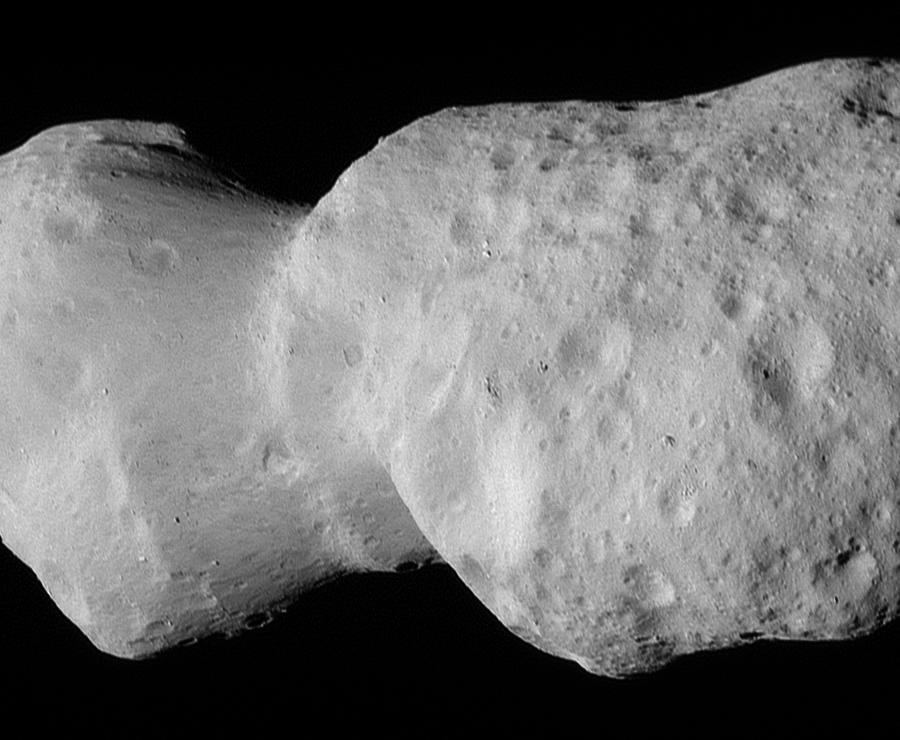
Donaldjohanson image credit: NASA
#4. What is the fate of our galaxy?
You may have heard that our Milky Way Galaxy is destined to collide with the Andromeda Galaxy, but a paper published this summer shows we can’t be so sure about that fate. Data from Hubble and the recently-retired Gaia spacecraft leave enough uncertainly in the masses and motions of these two major galaxies, along with their closest neighbors, that there was only a collision in 50% of the research team’s simulations. The gravitational pull of the Large Magellanic Cloud, a satellite galaxy of the Milky Way, may be enough to prevent the collision for at least 10 billion years.
#3. The most dangerous asteroid
We got another lesson in uncertainty from the asteroid 2024 YR4. Discovered late last year, this 200-foot wide space rock was the focus of many astronomers because initial observations showed a small chance of a collision with Earth in 2032. As more measurements were made, the odds of impact went up! By mid-February, 2024 YR4 had become the most dangerous known asteroid, with an impact probability just over 3%. Fortunately, by that time our planet was on the edge of the range of the asteroid’s possible approaches in 2032, and an impact was ruled out in short order. There is still a chance that 2024 YR4 will hit the Moon, and more observations will be needed to further clarify the asteroid’s fate.
#2. An interstellar visitor
On July 1st, astronomers spotted an interstellar visitor passing through our solar system, just the third such object known. Known as 3I/ATLAS, this comet is faster and larger than its two predecessors, and as it approached the Sun its coma revealed an unusual chemical composition, so it may well have a unique story to tell us about where and when it formed. There are already intriguing hints that 3I/ATLAS originated from a planetary system that is older than our solar system, and that it’s been altered by an extended journey through interstellar space, two features that make it quite different from any comet or asteroid in our solar system. As the year draws to a close, 3I/ATLAS has already made its closest approach to the Sun, and will soon recede from Earth’s view forever.
#1. Capturing the big picture
The biggest story of this year also came with a promise for an unprecedented level of discovery in the next decade, all thanks to one new telescope.

Ruben observatory image credit: NSF–DOE Vera C. Rubin Observatory
After more than two decades of planning and construction, the Vera C. Rubin Observatory captured its first views of the cosmos. Equipped with a large, uniquely-designed mirror and the largest digital camera in existence, the Rubin Observatory will be able to map the entire sky visible from its Chilean mountaintop every few nights. It will repeat these all-sky surveys for the next decade, helping astronomers spot things that move and change, like asteroids and comets, variable stars, and supernova explosions. The telescope is expected to collect vast quantities of data--up to 20 terabytes per night--and enable astronomers to study billions of stars and galaxies, while also quadrupling the number of objects known in orbit around the Sun. This 10-year survey may get underway as soon as December 31, so we can look forward to some amazing discoveries in 2026.