Anyone can participate in science!
Participatory science is a collaboration between scientists and public volunteers to gather new knowledge about the world. Participatory science includes community science, citizen science, community-based monitoring and other types of research that depend on knowledge, insights or observations from the public.
Participatory science can transform communities, advance research and help people across the globe. For example, over the last 10 years, 31,000 volunteers have classified 350,000 images of space! You don't have to be an expert to get involved in a project. With a wide variety of topics to choose from, there’s something for all ages. You can also join in as frequently as you're able.
Explore the Latest Participatory Science Opportunity — GLOBE Observer's Cloud Project
Having your head in the clouds can help science! By recording what you see in the sky, you can help NASA scientists better understand clouds and their role in Earth’s weather and climate. Your observations provide an important baseline record of cloud phenomena and help fill gaps in data that satellites aren’t able to capture.
You can help scientists by recording ground-level cloud observations with GLOBE Observer’s Clouds project. Cloud observations matched to satellite overpasses are especially helpful. Download the Globe Observer App to check the timing of satellite flyovers for your location. By pairing your ground-level observations with a satellite view from above, scientists can get a fuller picture of the clouds.
Scientifically, clouds are massive groups of tiny water droplets or ice crystals suspended in our atmosphere. Clouds play an important role in Earth’s weather and climate and are part of the water cycle, which is essential for life on Earth. Clouds produce rain, sleet and snow; provide shade on a hot day; trap heat on Earth’s surface at night; and reflect some of the Sun’s rays, helping keep the planet cool. That’s a lot of work!
So go ahead, keep your head in the clouds but level up by sharing what you see in the Globe Observer App!
Ongoing Participatory Science Opportunities
There’s no shortage of discoveries left to be made. Visit scistarter.org, zooniverse.org and citizenscience.gov to check out dozens of other participatory science opportunities. There’s something for everyone!
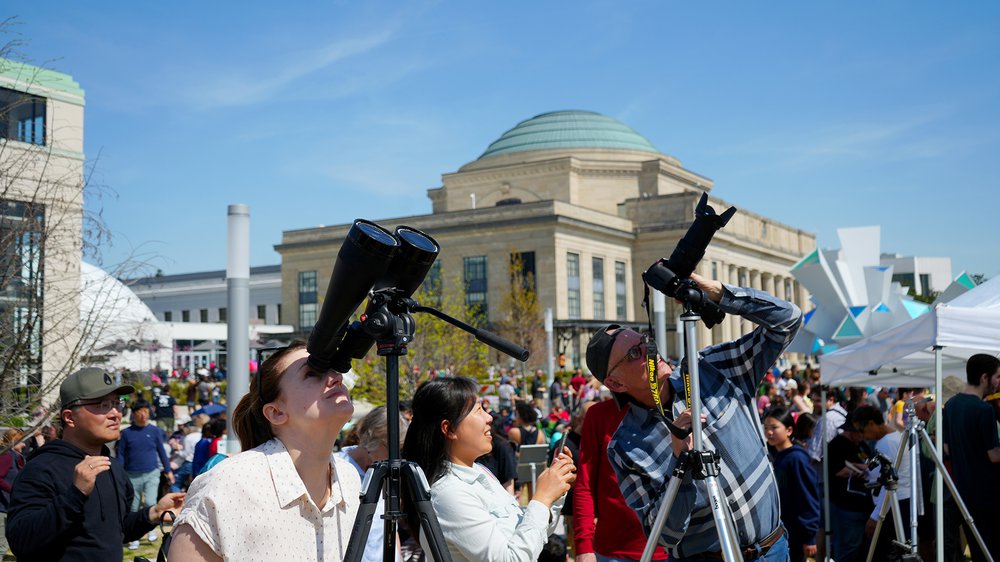
Participatory Science at the Science Museum
The Science Museum’s 2017 project Throwing Shade mobilized volunteers and partners from around Richmond to evaluate urban heat vulnerability. Data collected helped show that temperatures in the city during a heat wave can vary as much as 16 °F from the coolest to the warmest places.
From 2019 through 2023, volunteers helped the Science Museum collect data about hyperlocal air quality as part of RVAir. Funded in part by the Institute of the Museum and Library Services, RVAir worked with community collaborators to help measure particulate matter in Richmond neighborhoods.
Using portable AirBeam devices, community members collected air quality data on over 600 walks throughout the Richmond area. Additionally, over 35 permanent Purple Air sensors were installed across the city and are continuing to collect air quality in real time.